
TL;DR
CPM (cost per thousand impressions) turns raw reach into a cost you can judge, but cheap impressions aren't automatically good. This guide covers the CPM formula, worked examples across Meta, LinkedIn, and programmatic, when to use CPM vs CPC vs CPA, and how to optimize CPM without buying low-quality attention.
Key Takeaways
- 1CPM = (Total Ad Spend ÷ Total Impressions) × 1,000—it prices attention, not the value of the campaign itself
- 2Cheap reach isn't automatically good: one Meta study found a 30% lower CPM came with a 22% higher cost per qualified lead due to audience dilution
- 3Channel benchmarks differ sharply—programmatic $1–$3, Meta $8–$15, LinkedIn $25–$40—because audience value changes the price of exposure
- 4Use CPM for awareness and channel comparison, CPC when traffic quality is the concern, and CPA when finance needs cost per lead or sale
- 5Keep CPM efficient by refreshing creative every 7–10 days and tightening placements, frequency, and bids—without sacrificing lead quality
You're probably looking at a report right now that says your campaign delivered a lot of impressions, spent a meaningful slice of budget, and somehow still leaves one basic question unanswered: was that reach worth paying for?
That's where marketers get stuck. Impressions look like progress because the numbers are big. But big numbers don't tell you whether your ad was bought efficiently, whether the audience was qualified, or whether the campaign is helping revenue. A founder sees visibility. A media buyer sees auction cost, audience quality, and the first clue about future ROAS.
A good cost per impression example doesn't just show the math. It shows what the math means when you're deciding whether to scale, cut spend, refresh creative, or move budget to another channel. That's the part most CPM explainers miss, and it's the part that matters.
Your Ad Spend and a Sea of Impressions
A common scenario looks like this. A brand launches Meta, LinkedIn, or display ads, then opens the dashboard a few days later and sees one thing immediately: impressions are piling up. The campaign looks active. Delivery is happening. Spend is moving.
But impressions by themselves are just exposure. They don't tell you whether you bought that exposure efficiently, whether the right people saw the ad, or whether those views have any chance of turning into pipeline or sales.
That's why cost per impression, and more practically CPM, matters so much. It gives you a way to translate raw reach into a cost you can evaluate. Once you know what it cost to generate visibility, you can start asking better questions. Was the campaign expensive for the audience you targeted? Is one platform charging a premium that your margins can't support? Does a low CPM help, or is it buying low-quality attention?
CPM is rarely the final KPI for a performance team. It's the first diagnostic metric that tells you how expensive visibility is before you judge traffic, leads, or purchases.
In awareness campaigns, CPM is often the main buying metric. In performance campaigns, it still matters because it shapes how much room you have left for clicks, conversions, and eventual ROAS. If your impression cost is bloated, everything downstream gets harder. If your impression cost is cheap but the audience is weak, the campaign can still fail.
That's the tension. Cheap reach isn't automatically good, and expensive reach isn't automatically bad. The value sits in what kind of audience you reached and what those impressions are likely to do for the business.
What Is Cost Per Impression and Why We Use CPM
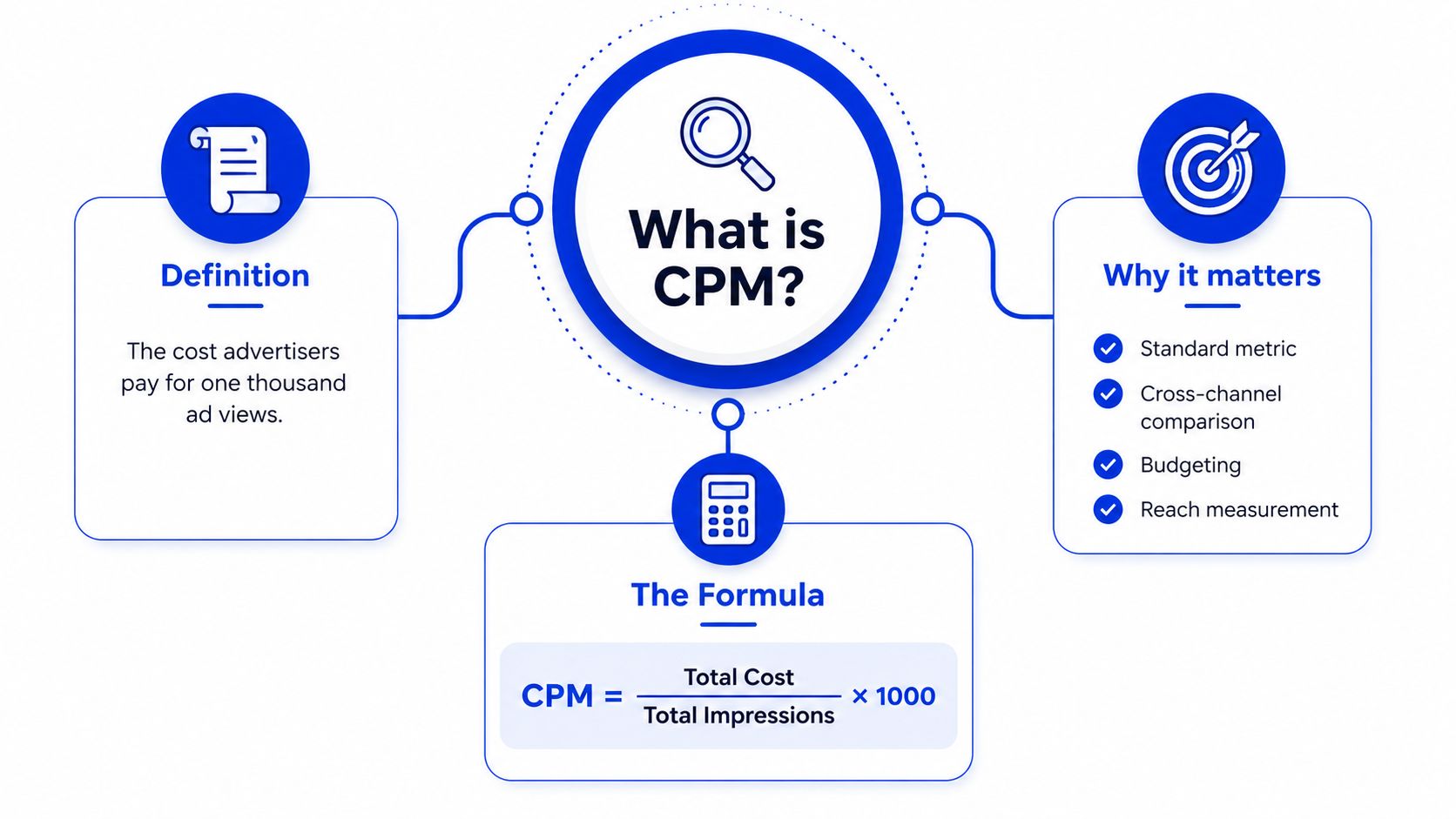
Cost Per Impression (CPI) is the literal cost of a single ad view. In practice, buyers don't talk that way very often. They use CPM, which means cost per thousand impressions. As noted in Martechdo's explanation of cost per impression, CPI is the literal cost for a single view, whereas CPM is the industry-standard pricing model for every 1,000 views.
Why teams talk in thousands
Think about it like buying eggs. You can describe the price of one egg, but stores usually price them by the dozen because that's the useful unit for comparison. Ad buying works the same way. A single impression is too small to be practical, so the market standardizes the metric at 1,000 impressions.
That does two things:
- Makes planning easier because you can estimate reach at campaign scale.
- Improves channel comparison because Meta, LinkedIn, YouTube, and display can all be judged with the same base unit.
- Helps with budgeting because media buyers usually need to model spend before launch, not after.
If you're trying to compare a broad awareness campaign on Meta to a niche B2B campaign on LinkedIn, CPM gives you a common language. You still need context, but at least you're comparing like with like.
The formula you actually use
The calculation is simple:
CPM = (Total Ad Spend ÷ Total Impressions) × 1,000
That formula matters because it turns delivery data into a number you can act on. If impressions go up without spend rising at the same pace, your CPM improves. If spend rises faster than impressions, CPM worsens.
Practical rule: use CPM to judge the price of attention, not the value of the campaign by itself.
The distinction matters more than most guides admit. You can buy cheap impressions and still get poor business results. You can also pay a premium CPM for a high-intent audience and come out ahead because the conversion value justifies the cost.
A useful cost per impression example always has two layers. First, the arithmetic. Second, the business interpretation. Without the second part, CPM becomes a vanity metric with better branding.
Cost Per Impression Examples Across Different Channels
Channel benchmarks are useful because they show how the same CPM math leads to very different buying decisions.
Example one: Meta reach at consumer scale
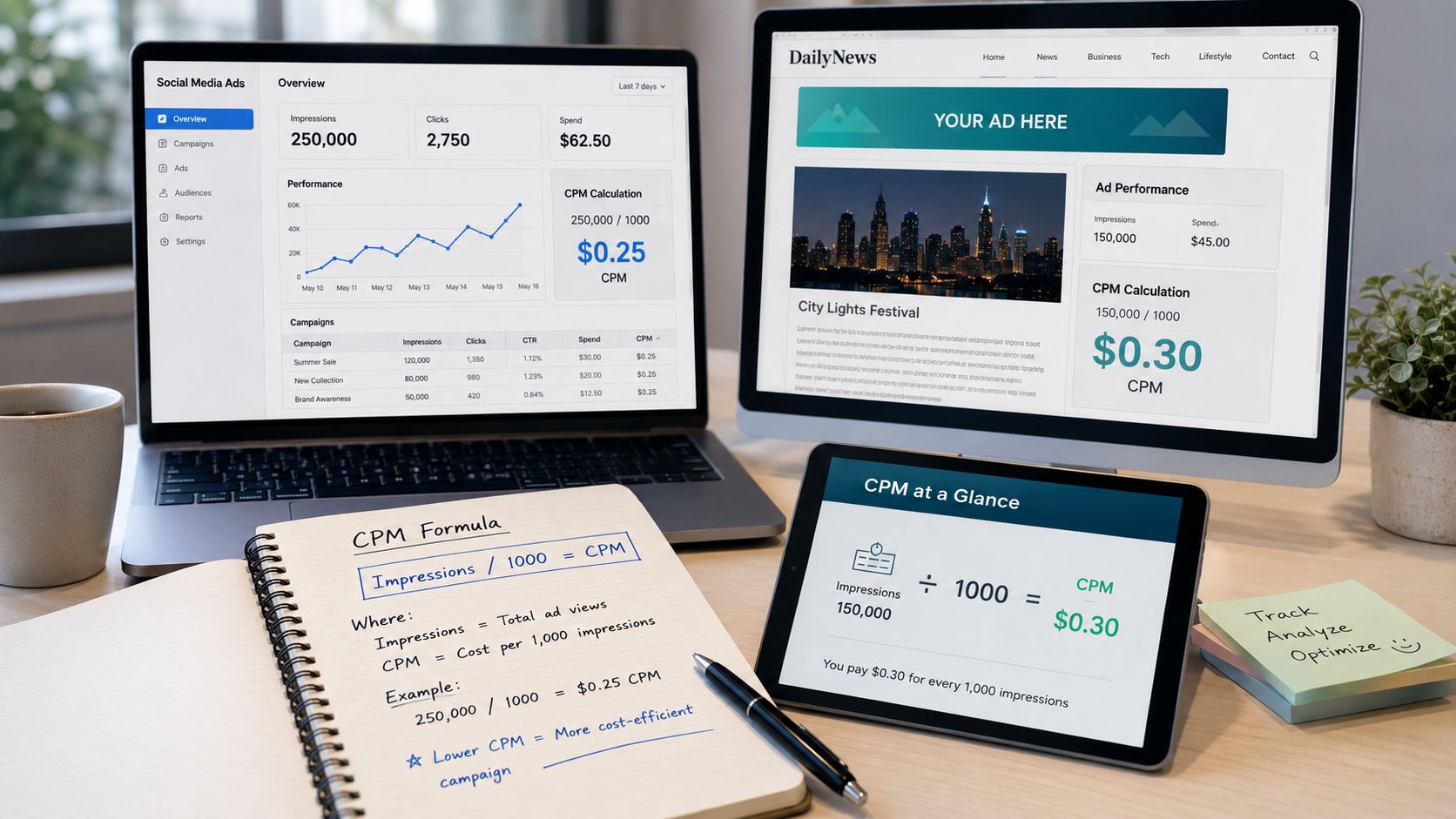
Start with a straightforward paid social case. A $300 Meta campaign that generates 30,000 impressions produces a $10 CPM, calculated as (300 ÷ 30,000) × 1,000.
The math is simple:
- Ad spend: $300
- Impressions: 30,000
- Calculation: (300 ÷ 30,000) × 1,000
- Result: $10 CPM
What matters is what that $10 is buying. For many consumer brands, Meta can deliver efficient reach and fast creative testing at scale. That makes it useful for prospecting, offer testing, and top-of-funnel demand generation.
A low Meta CPM still needs scrutiny. If impressions come from broad placements, weak audience filters, or low-attention inventory, the campaign can look efficient in-platform and still miss revenue targets. Teams testing emerging placements can use this guide to Threads advertising creative formats and best practices to judge whether the inventory fits the campaign goal.
Example two: LinkedIn reach for B2B buyers
LinkedIn usually costs more because the audience is harder to reach and often more commercially valuable. As noted in AdLibrary's CPM rate breakdown, LinkedIn commonly runs in the $25 to $40 CPM range, while Meta often falls in the $8 to $15 range and programmatic display in the $1 to $3 range.
That price gap changes how a media buyer reads performance.
If a B2B SaaS company pays a $30 CPM on LinkedIn, that can still be the better buy than a $10 CPM on Meta if LinkedIn is reaching operations leaders, finance stakeholders, or decision-makers tied to pipeline. In that case, the higher CPM may improve ROAS because fewer impressions are wasted on people who will never buy.
This is the mistake I see often. A team shifts budget toward the cheaper platform, celebrates the lower CPM, and then wonders why qualified lead volume drops. The problem is not the metric. The problem is treating cheap reach as qualified reach.
Example three: programmatic display for broad awareness
Programmatic display usually wins on cost. It often loses on audience quality unless targeting, placement controls, and frequency management are handled well.
Here is the planning view:
- Programmatic display, $1 to $3 CPM: broad awareness and low-cost reach.
- Meta, $8 to $15 CPM: consumer reach with stronger creative testing.
- LinkedIn, $25 to $40 CPM: professional targeting and B2B precision.
A display CPM in the low single digits can be useful when the goal is wide reach, retargeting support, or efficient top-of-funnel coverage. It can also burn budget quickly if the impressions are technically delivered but commercially weak. Poor placements, low viewability, and loose audience targeting can all produce a CPM that looks excellent on a dashboard and performs badly in the funnel.
That is why channel comparison should never stop at price. The better question is which CPM gives you the strongest path to revenue. Sometimes that is the cheapest inventory. Often it is the channel that reaches the right buyer, even at a premium.
CPM vs CPC vs CPA: Choosing the Right Metric
Teams often frame this as a fight between metrics. It isn't. CPM, CPC, and CPA do different jobs, and the right one depends on what you're trying to buy: attention, visits, or outcomes.
A quick comparison
- CPM, you pay per 1,000 impressions: the goal is awareness. Best for reach, visibility, and top-of-funnel campaigns.
- CPC, you pay per click: the goal is consideration. Best for traffic, landing page visits, and content consumption.
- CPA, you pay per acquisition or conversion: the goal is conversion. Best for leads, purchases, sign-ups, and bottom-funnel efficiency.
The mistake is optimizing the wrong metric for the wrong stage. If your goal is mass visibility, CPC can be too narrow because it ignores all the people who saw and remembered the ad but didn't click. If your goal is purchases, CPM can be too far upstream unless you keep tying it back to downstream quality.
When CPM is the right call
CPM works best when reach itself has value. That's common in launches, awareness pushes, remarketing support, and top-of-funnel demand generation. It's also useful when you need to compare how expensive different channels are before click and conversion data has stabilized.
Industry context matters here. According to Newor Media's industry CPM benchmarks, Finance & Insurance averages $20 to $45 and Tech & SaaS $15 to $40, while Retail & eCommerce sees $5 to $15. That gap tells you something important: audience value changes the price of exposure.
A retailer chasing broad consumer demand may see a workable campaign at a lower CPM than a SaaS brand targeting decision-makers. That doesn't mean retail marketers are better buyers. It means they're participating in a different auction.
Use CPM first when:
- You need reach and aren't judging the campaign solely by clicks.
- You're comparing channels before enough conversion data exists.
- You want to diagnose auction pressure caused by audience, placement, or creative.
Use CPC when traffic quality is the main concern. Use CPA when finance needs to know exactly what it cost to generate a lead or sale.
The right metric is the one closest to your actual objective. If you care about purchases, don't let a pretty CPM distract you from a bad CPA.
That said, strong performance teams still watch CPM even in conversion campaigns. If the cost of getting seen rises too far, CPA usually follows. CPM isn't the finish line, but it often signals trouble before the deeper funnel numbers do.
Actionable Tactics to Optimize Your CPM
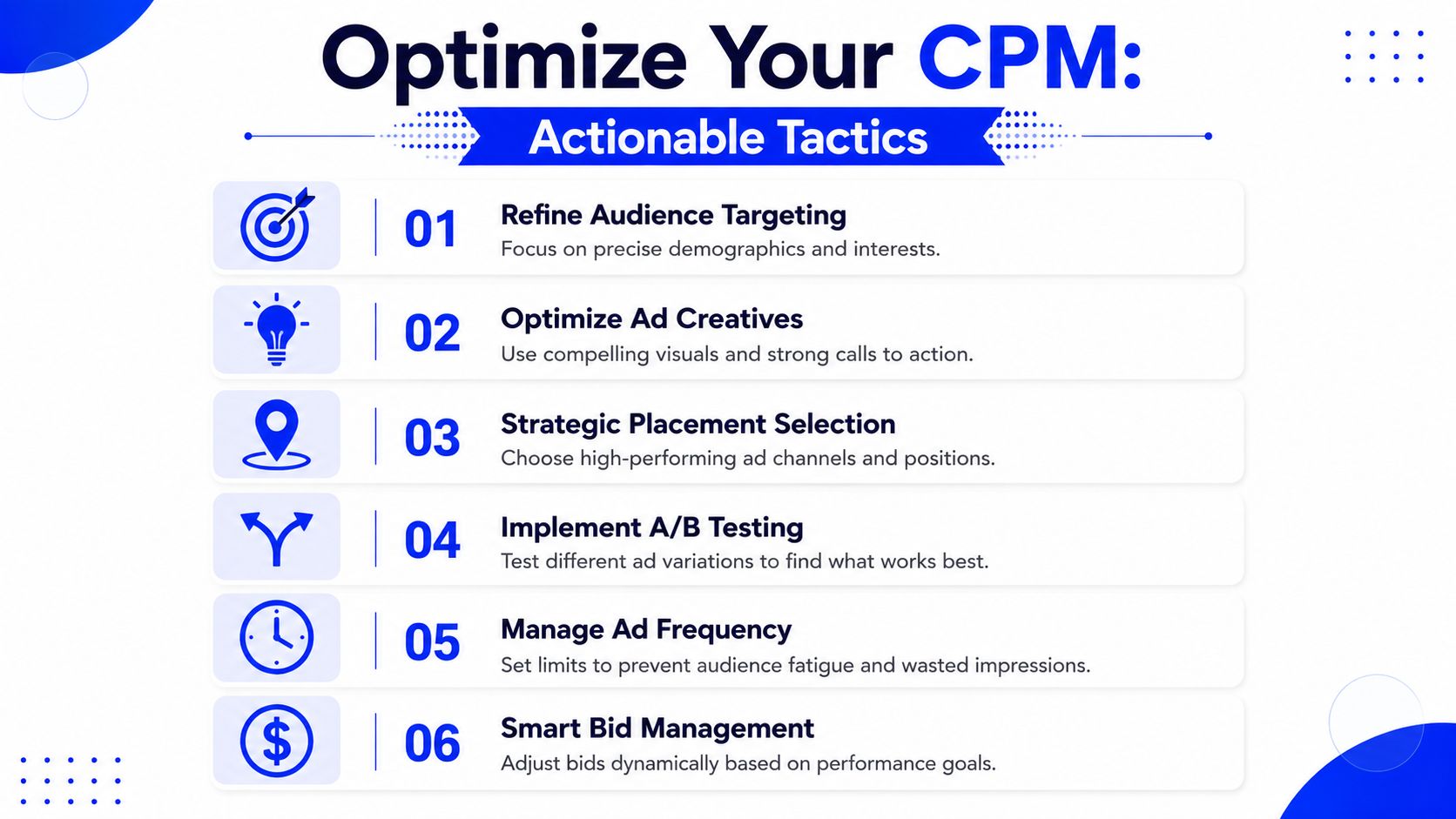
Most CPM problems come from a handful of levers: stale creative, mismatched audiences, bad placements, or loose bidding discipline. Fixing them usually doesn't require a total account rebuild. It requires better operating habits.
Creative and audience levers
Creative fatigue is one of the fastest ways to lose efficiency. According to Triple Whale's CPM guide, keeping CPM below $15 on Meta often requires refreshing hooks every 7 to 10 days, because static assets can push CPM up 20 to 30% within 14 days.
That lines up with what media buyers see in live accounts. People stop responding to the same ad. Meta reads that drop in engagement, and auction costs get worse.
A few practical moves help:
- Refresh hooks fast: don't wait for a campaign to fully collapse. Swap the opening angle, headline, or first-frame visual before fatigue is obvious.
- Tighten audience quality: if the audience is too broad, you may lower CPM and still worsen business results. If it's too narrow, the auction can get expensive. The sweet spot is relevance with enough scale.
- Test message fit, not just design: a plain ad with a sharper promise often outperforms a polished asset that says nothing useful.
If your team needs better creative testing discipline, this guide on high-converting ad creatives that drive results is worth reading.
Placement and bidding discipline
Placements matter because they expose your ads to different inventories, user behavior patterns, and competition levels. A campaign can look expensive because it's overcommitted to premium placements that don't earn their keep.
Use this checklist:
- Review placement mix: feed, Stories, Reels, YouTube, display, and professional inventory all price differently. Don't assume the default mix is best.
- Watch frequency: if the same users see the ad too often, engagement drops and CPM often drifts up with it.
- Control bids with intent: when the platform gives you bidding options tied to impressions, use them deliberately. The bid model should match the campaign's actual purpose.
- Compare CPM with downstream quality: a lower CPM only counts as a win if the traffic, leads, or purchasers remain strong.
Better creative usually lowers CPM because platforms reward ads that hold attention and generate engagement.
The important point is that CPM optimization isn't a cheapness game. It's an efficiency game. Lowering CPM while damaging lead quality doesn't help. Lowering CPM while preserving sales efficiency does.
Beyond CPM: Connecting Impressions to ROAS
Many teams make a mistake here. They treat a falling CPM like automatic progress. Sometimes it is. Sometimes it's just cheaper waste.
The clearest example comes from a 2024 Meta study cited by Indeed. It found that campaigns with 30% lower CPM had a 22% higher cost per qualified lead due to audience dilution. That's the trap. The campaign looked more efficient on the surface because impressions got cheaper. In reality, the audience got weaker, and the business paid for it later.
That's why CPM should sit inside a wider performance view:
- Check who saw the ad, not just how cheaply you reached them.
- Compare impression cost with lead or purchase quality.
- Judge success by ROAS and qualified outcomes, not dashboard vanity.
This matters even more as tracking changes and audience quality becomes harder to infer from cheap inventory alone. The shift is part of the broader change covered in this piece on how the end of third-party cookies is transforming digital marketing.
A strong media buyer doesn't ask, "How low is my CPM?" The better question is, "Is this CPM buying attention that can realistically turn into revenue?"